 INDOCHINA CARTACARO.COM
A year ago, we promised to unveil Captain Péri’s rare photographs of the 1909 Battle of Yen Thé. Today, the wait is over! Over 80 never-before-seen images are now available.
The organization of the Poulo Condore penal colony
Poulo Condore
The penitentiary was less harsh than the Guyanese penal colony. As proof, the "tough guys" whom Poulo Condore couldn’t control were sent to Cayenne, where they were brought into line.
But, on the other hand, the Cochinchinese penal colony was not "the coconut penal colony."
Discipline varied according to the directors.
And not all convicts were subject to the same regime.
Depending on the crime they had committed, they were sent to one of the penitentiary’s three sections : penal colonies 1, 2, and 3.
Prison 1, located in the heart of the village, housed common criminals, generally murderers, pirates, and escape masters, whose only source of income was a lengthy criminal record.
With their fierce gaze, shaved heads, and bodies tattooed with dragons, phoenixes, and even Chinese characters, these prisoners were divided into large communal cells with concrete bunks and iron bars, which, at night, clamped around their ankles.
During the day, they broke coral to build roads or burned it in lime kilns to extract high-quality calcium.
Prison 2, near Prison 1, was more cerebral.
It housed political prisoners, most of whom were students fighting for independence.
Here, there was no danger for the guards of being knocked out from behind, as with the common criminals. Always very well-groomed, not smoking or gambling, these inmates spent their days studying the works of Lenin and Karl Marx.
However, boredom was the strongest, and many asked for work.
So, they were kept busy making nets, ropes, clothing, tortoiseshell objects, tin kitchen utensils—in short, anything as long as it helped them get rid of their depression.
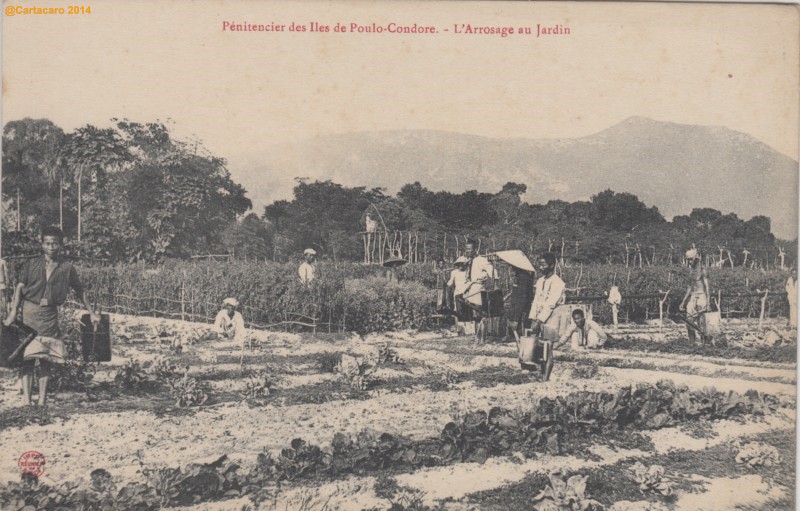
Cochinchine - Poulo Condore
L’arrosage au jardin
#61
L’arrosage au jardin
#61
Completely different was Penal Colony 3.
Located at the edge of the village, it housed the stubborn, imprisoned for attempted escapes or the murder of guards or fellow inmates. Held in shackles, often in pairs or threes, in cramped cells with wire mesh ceilings, the dreaded "tiger cages," they had nothing to do but wait for better days.
But there was worse : the hulling factory, a small prison within the great prison, the terror of all convicts, which they called the “second hell.”
In a dark shed where the sun never reached, a hundred nearly naked men, covered in sweat, operated, in a cloud of noise and dust, rustic machines to separate the paddy grains from their husks.
"They looked like barbarian slaves turning the Roman oil mills, as seen in ancient history books," reports J.C. Demariaux. There they found the aristocracy of the kingdom of the rabble, the caïds, whom the dungeon had not been able to correct.
D’aprés : archive.today selection-1117.0-1365.1